

Do Membrane Filter Bags Need Precoating? When and Why
When precoating is needed and when it is not, plus powder dosage and injection steps
Precoating is the step of injecting a fine powder at the inlet side before process dust reaches new filter bags, so that a thin, even initial dust layer forms on the bag surface.
The deciding question is what reaches the bag surface first at start-up. Dosages in public sources are about 205–250 g per m² of filter area, and about 390–440 g in a source for coal-fired boilers using limestone. After injection, cleaning stays off until pressure drop rises to a set level.
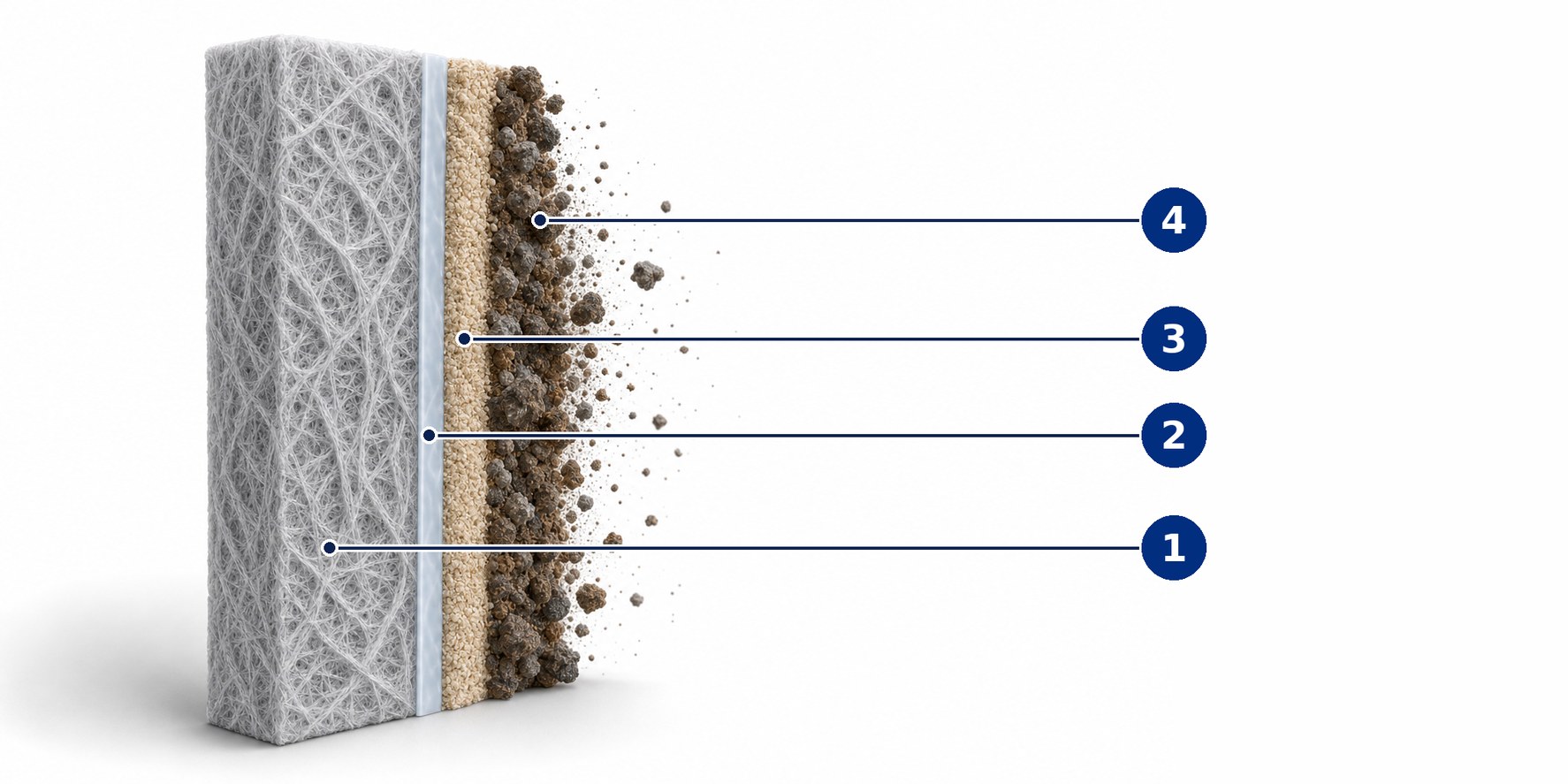
Layer thickness and proportions are exaggerated for clarity; not actual shape or dimensions.
Source: Based on Micro-one in-house technical data · AI-assisted concept illustration · Not actual shape or dimensions
01 · WHAT IS PRECOAT
What Does Precoating Do?
The high collection efficiency of a baghouse comes mainly from the dust cake that builds up on the bag surface.[1] This principle is covered in the column "Depth Filtration vs. Surface Filtration: What Is the Difference?"
With woven and nonwoven (felt) media, particles can pass through for a short time until the dust cake re-forms.[1] Precoating builds that cake in advance with a powder instead of process dust. The US EPA Air Pollution Control Cost Manual also describes precoating as injecting a powder at the inlet to form a protective dust layer.[1]
Limestone, Hydrated Lime and Perlite Are Typical Powders
Academic studies have tested hydrated lime and dolomitic limestone as precoat powders,[2] and an industry association describes perlite as a precoat powder.[3] A Micronics document on membrane bags for coal-fired boilers lists its order of preference as a proprietary precoat powder, then limestone, then dry fly ash or a blend of limestone and fly ash.[4]
Precoating Serves Four Purposes
- Preventing clogging by sticky particles: One study found that a layer of powder such as hydrated lime keeps sticky ultrafine particles from clogging the filter media, maintaining collection efficiency above 99% with biomass combustion dust.[5]
- Absorbing moisture: It reduces wetting of the filter media during start-up.[4]
- Neutralizing acids: Where condensable acid gases are a concern, an alkaline powder is preferred.[4]
- Protecting the bag surface: One source explains that the powder layer acts as a barrier between process dust and the bag, and also protects the bags during shutdowns.[6]
02 · MEMBRANE VS FELT
Do Membrane Filter Bags Need Precoating Too?
On a membrane filter bag, filtration takes place mainly at the membrane surface, and fine particles are captured almost immediately after filtration begins.[1] For this reason, some manufacturer literature states that precoating is not needed. Menardi explains that the membrane acts as the primary dust cake, so no precoat is required before or during operation.[7] In an academic test with fine steelmaking dust, however, PTFE membrane media gave the highest nanoparticle efficiency, but its pressure drop rose faster than that of precoated conventional media, so it completed the same 30 filtration cycles in less time.[2]
There are also cases pointing the other way. A Micronics document on starting up a coal-fired boiler on diesel recommends precoating even for membrane filter bags, because VOCs from diesel combustion can condense inside the membrane structure and blind the pores.[4] It strongly recommends precoating whenever there is any chance that parts of the bag surface are left uncovered by fly ash, and states that the risk is higher with ePTFE laminates.[4]
Another manufacturer's start-up procedure states that precoating before start-up is mandatory for single-compartment high-temperature collectors, and that when starting up on diesel, following the procedure only reduces, and does not eliminate, the chance of bag blinding from the start-up fuel. This document is the company's procedure for its ePTFE laminate bags (Preveil®).[8]
A Test Study Compared Precoated Media With Membrane Media
A master's thesis from the Federal University of São Carlos in Brazil reports that precoating polyester-based media with limestone or diatomaceous earth raised collection efficiency for steelmaking dust. The PE/PTFE membrane medium used as the benchmark showed collection efficiency above 94% for micro- and nanoparticles.[9] These are results from one set of test conditions and should not be read as field performance or as the performance of DuraFill™.
In the end, the deciding question is what reaches the bag surface first at start-up. DuraFill™ is an ePTFE membrane filter bag with a membrane pore size of 1 µm or less. The sources above concern membrane filter bags in general. If the conditions below apply, precoating for DuraFill™ can be reviewed against the same criteria.
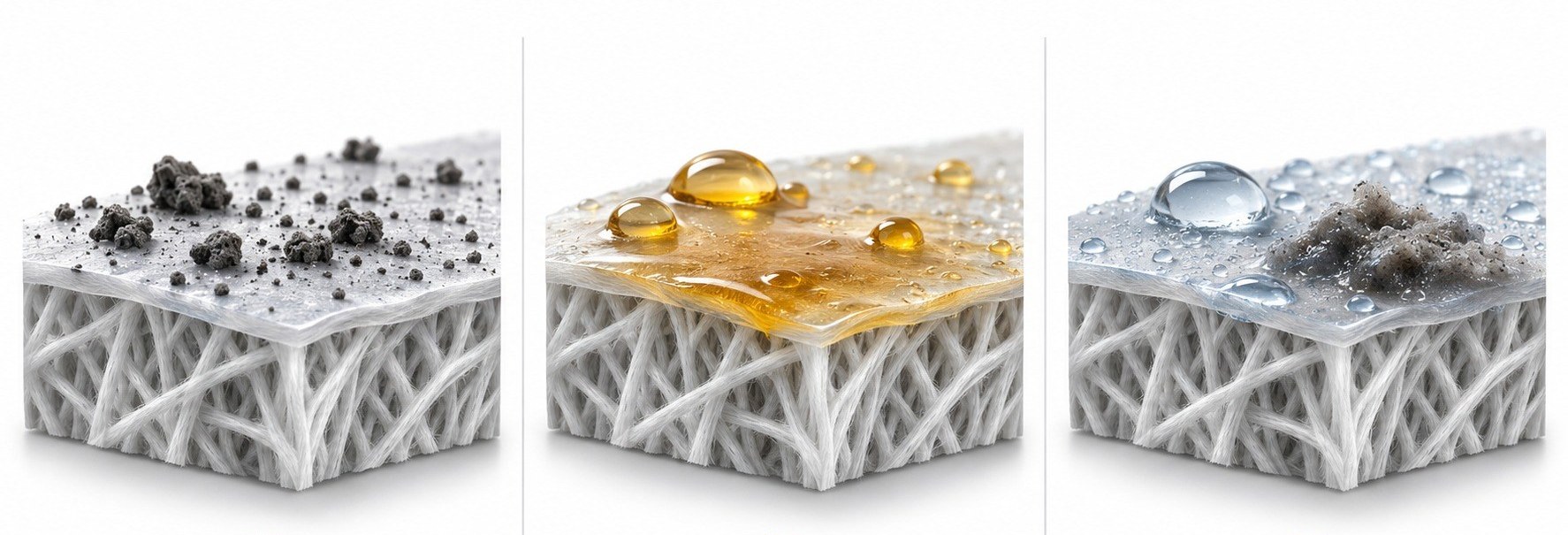
From left: dry dust, oil and moisture reaching the bag surface; a concept illustration, not actual shape or dimensions.
Source: Based on Micro-one in-house technical data · AI-assisted concept illustration · Not actual shape or dimensions
| Start-up condition | What can happen at the bag surface | Precoating |
|---|---|---|
| Start-up on diesel or oil-fired auxiliary burners | VOCs from combustion can condense inside the membrane structure and blind the pores[4] | Recommended |
| Moisture or condensable acid gases expected during start-up | Moisture can reach the media and acid gases can condense[4] | Recommended (alkaline powder preferred; lime can cake when moisture is high[10]) |
| Dust containing sticky residues | Sticky ultrafine particles can clog the filter media[5] | Recommended |
| Dry dust with no oil or moisture | The membrane is described as acting as the dust cake from the start[7] | Not required |
| Processes that sell collected dust as product or return it to the process | Precoat powder mixes into the collected dust[6] | Not suitable |
This table summarizes public sources by condition; actual needs depend on site conditions. To check for condensation, compare the gas temperature during start-up with the acid dew point guide.
03 · HOW MUCH
How Much Precoat Powder Should You Use?
Most public sources specify dosage as powder weight per unit of filter area. Because the units vary, the table converts them to g/m². The g/m² values were converted by us for this article.
| Source | As stated | Converted to g/m² | Application |
|---|---|---|---|
| Perlite Institute[3] | 0.25 kg/m² (minimum) | 250 or more | Baghouse filter media (perlite, etc.) |
| ICT Filtración[6] | 25 kg/100 m² | 250 | Filter bags (per product page) |
| Micronics[4] | Proprietary powder approx. 42 lb, limestone or blend 80–90 lb / 1,000 ft² | approx. 205 / approx. 390–440 | ePTFE membrane bags (coal-fired boilers) |
Conversion basis: 1 lb/ft² ≈ 4,882 g/m². The sources differ in equipment and powder, so the values should not be compared directly.
In the Micronics document, the amounts for proprietary powder and for limestone or blended powder differ by about a factor of two.[4] That is why layer thickness is also specified alongside weight. The Perlite Institute procedure says to confirm a layer about 1 mm thick after injection.[3] The exact amount depends on the powder type and the supplier's instructions.
04 · HOW TO INJECT
How Do You Apply Precoat, and How Do You Know It Is Done?
Public sources broadly agree on four steps.
Inject With the Fan Running and Cleaning Locked Out
The Perlite Institute procedure first empties dust from the hoppers, shuts off the discharge equipment and turns off the cleaning cycle. Airflow is then reduced to about 50% of design, and powder is fed through a port or access door in the duct.[3]
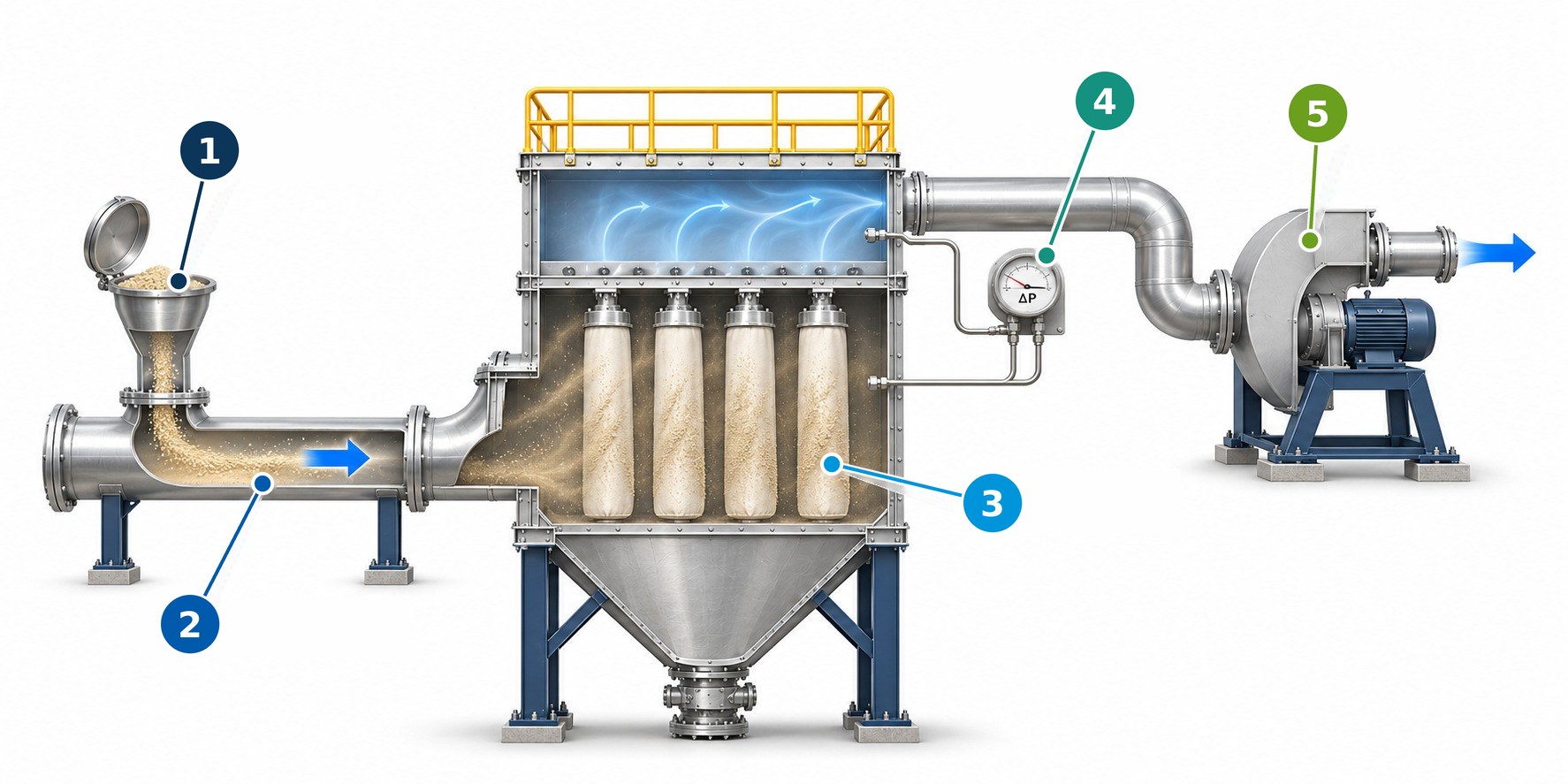
- Injection portPort or access door where powder is fed
- Inlet ductPath where the gas stream carries powder to the bags
- Filter bagsWhere the precoat layer forms on the surface
- Differential pressure gaugeShows when cleaning can be turned back on
- FanKept running during and after injection
Concept view of feeding powder into the inlet duct with the fan running; not the actual equipment layout.
Source: Based on Micro-one in-house technical data · AI-assisted concept illustration · Not actual shape or dimensions
Set the Feed Rate to the Reduced Airflow
The Perlite Institute gives 0.136 kg (0.3 lb) per minute per 1,000 ACFM of reduced airflow and a velocity of about 10.1 m/s.[3]
Check That the Precoat Covers the Bags Evenly
After injection, check that each compartment is evenly covered and that not too much powder has dropped into the hoppers. The Perlite Institute procedure says to isolate a compartment and confirm a layer about 1 mm thick.[3] Set the exact thickness on site from the supplier's instructions.
Hold Cleaning Until Pressure Drop Reaches a Set Value
Even after airflow is raised to design and hopper discharge restarts, cleaning stays off until pressure drop reaches a set level,[3] so the precoat layer is not knocked off. That set value differs by source.
- Perlite Institute: 3–4 in. w.c. (approx. 76–102 mmH₂O)[3]
- Parker (BHA) start-up procedure: When starting new bags, cleaning does not begin until dust loading starts and pressure drop has risen by 1–3 in. w.c. (approx. 25–76 mmH₂O).[8]
Set the value from the baghouse's design pressure drop and the supplier's instructions. How to read pressure drop is explained in the pressure drop checklist guide. The full start-up procedure for new filter bags will be covered in an upcoming column, "How Should New Filter Bags Be Started Up and Shut Down?"
05 · WHEN & WHAT NOT
When Should You Precoat Again, and Which Powders Should You Avoid?
In processes that use precoat, one application at start-up may not be the end of it. Precoat is applied again after new bags are installed or replaced, and some sites apply it before a shutdown.[6]
Each Powder Has Its Own Cautions
- Lime: Alkaline, but reported to cake in the presence of moisture, blinding filters and raising pressure drop.[10]
- Fly ash: Reported to have high bulk density, to be abrasive and to release from the fabric under pressure.[10]
- Diatomaceous earth: The test study above reported that its small particles fill pores quickly, so pressure drop rises faster.[9]
- Processes that return collected dust: Reported as unsuitable for filters whose collected dust is bagged for sale or fed straight back into the process.[6]
For Catalytic Filter Bags (CataFill™), Check the Powder Composition First
CataFill™ is a catalytic filter bag made by laminating an ePTFE membrane onto a catalyst-loaded PTFE nonwoven. When choosing a precoat powder, first check whether it contains components that can poison the catalyst.
A public demonstration report supported by the Danish Environmental Protection Agency names potassium, sodium, phosphorus and calcium as DeNOx catalyst poisons, and states that sodium, potassium, magnesium and calcium can act as catalyst poisons.[11] The report covers one case: a third-party product, tested at a mainly straw-fired power plant, that places catalyst-impregnated glass fiber inner bags (no membrane) inside conventional filter bags. Because the design and conditions differ, it should not be read as CataFill™ performance or as a product comparison.
Calcium-based powders such as limestone and hydrated lime, and sodium-based powders, are commonly used as precoats or sorbents, so their suitability for catalytic filter bags needs to be checked separately. The plant in the report above also operated with lime injected upstream of the baghouse, so composition alone does not settle whether a powder can be used. For catalytic filter bags, check the powder's composition sheet first and follow the supplier's operating instructions when selecting a powder. The causes of poisoning are explained in the column "Why Do SCR Catalysts Deactivate? Poisoning, Temperature and Ammonia Slip." Topsoe's catalytic filter bag FAQ also assumes a dust layer built up after precoating.[12]
FAQ
Frequently Asked Questions
Are membrane filter bags ever precoated?
Yes. Manufacturer literature recommends precoating for start-up on diesel and for processes where moisture or condensable acid gases are a concern during start-up. Other manufacturer literature says it is not needed for ordinary dry dust. The deciding question is what reaches the bag surface first at start-up.
What powders are used for precoating?
Public sources often cite limestone (calcium carbonate), perlite and diatomaceous earth, and a source on membrane bags for coal-fired boilers lists a proprietary powder, limestone and a limestone/fly ash blend. Alkaline powders are preferred when acid gases are present, but some powders cake on contact with moisture, so the choice depends on process conditions and the supplier's instructions.
Should cleaning be paused after precoating?
Yes. Keep cleaning off until pressure drop rises to a set level so the precoat layer is not knocked off. Public sources use 3–4 in. w.c. (approx. 76–102 mmH₂O).
Do you need to precoat again after replacing filter bags?
Yes. In processes that use precoat, it is applied again after a new set of bags is installed or replaced. Some sites also reapply it before a long shutdown or after process upsets that let in moisture or oil.
- US EPA, "Air Pollution Control Cost Manual, Section 6, Chapter 1: Baghouses and Filters" (EPA/452/B-02-001), 1998, pp. 1-4, 1-17, 1-31, 1-34, 1-44. Link
- Andrade, B. K. S. A., Sartim, R., Aguiar, M. L., "Precoating Effects in Fine Steelmaking Dust Filtration," Atmosphere 13(10), 1669, 2022 (peer-reviewed journal article). Link
- Perlite Institute, "Perlite Filter Aid: Precoat for Baghouse Fabric Filters," 2024 (industry association literature). Link
- Micronics, "Pre-Coating Recommendations: Start-up of a Coal-Fired Boiler With ePTFE Membrane Filter Bags," 2022 (manufacturer literature). Link
- Schiller, S., Schmid, H.-J., "Highly efficient filtration of ultrafine dust in baghouse filters using precoat materials," Powder Technology, pp. 96–105, 2015 (peer-reviewed journal article). Link
- ICT Filtración, "Pre-coating for bags and cartridges," product page (manufacturer literature). Link
- Menardi, "Mikrotex PTFE Membrane," brochure (manufacturer literature). Link
- Parker Hannifin (BHA), "Start-Up Procedures" (manufacturer literature). Link
- de Melo, B. R., "Precoating: uma alternativa mais econômica…," master's thesis, Federal University of São Carlos (UFSCar), 2021. Link
- Micronics, "Benefits of Using Precoat Filter Aid in Your Baghouse?," 2017 (manufacturer literature). Link
- Danish Environmental Protection Agency (Miljøstyrelsen), MUDP, "CataFlex catalytic bags at Snetterton," 2022, pp. 10, 12, 14, 22, 24. One case involving a third-party product with a different design and conditions. Link
- Topsoe, "CataFlex™ catalytic filter bags," product page FAQ (manufacturer literature). Link