

What Types of Holes Occur in Filter Bags?
From hole location to mechanical causes, operating conditions, dust properties and what to record before replacement
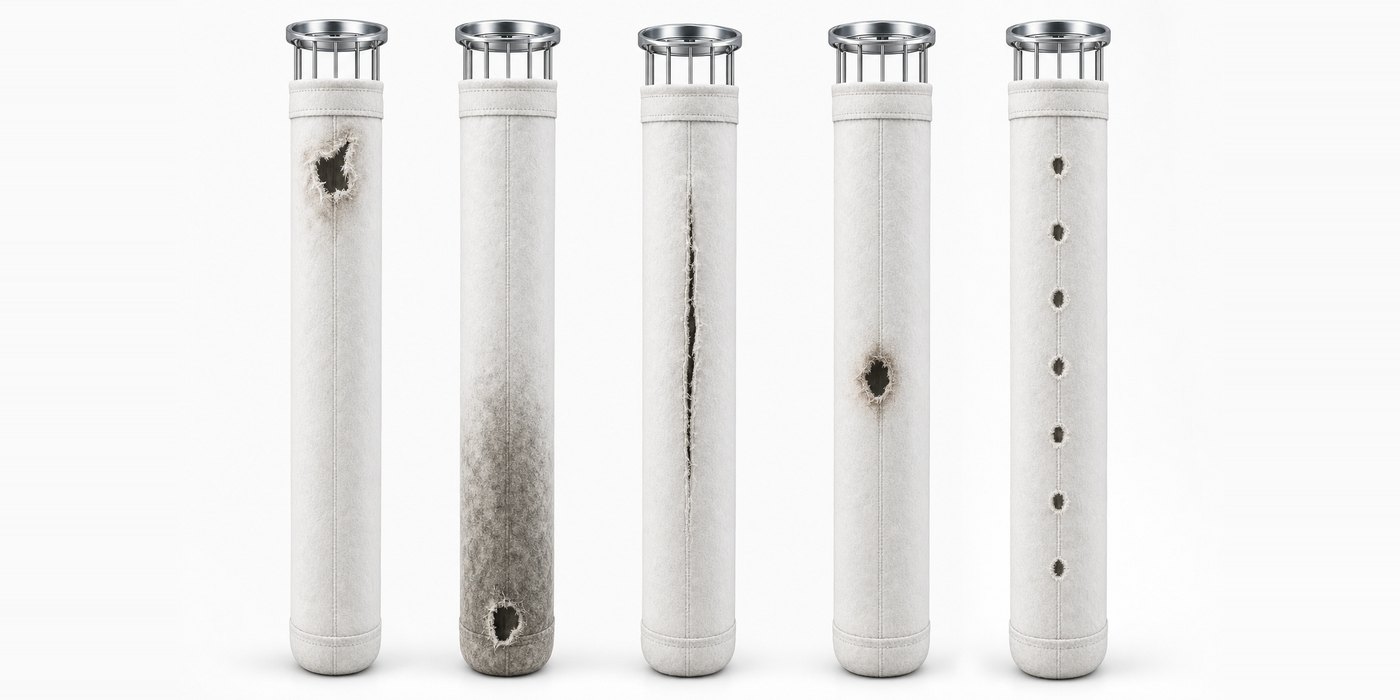
- Top: just below the tubesheet
- Bottom: wear and holes near the bottom
- Seam: splits along the vertical seam
- Random spot: a hole in the middle of the surface
- Holes in a row: small holes in a line along a cage wire or ring
Concept illustration to explain the types; actual shapes and dimensions differ.
Source: Micro-one Co., Ltd. · AI-assisted concept illustration · not to scale
01 · WHERE IT FAILED
What Does the Hole Location Tell You?
The suspected cause depends on the height and shape of the hole. Look not only at a single bag but also at how the failed bags are distributed inside the baghouse.[1]
- ① Top: If a blowpipe is off center from the bag, high-velocity air can abrade the inside of the bag and lead to early failure.[2] Abrasion that starts on the inside near the top can be a sign that dust collected on the clean side was blown into the bag during pulsing.[1]
- ② Bottom: Poor inlet design can make dust-laden gas strike specific spots such as the bottom cuff.[4] Local high gas velocity and dust re-entrained from the hopper also cause abrasion.[1] A blocked hopper that backs up dust causes the same abrasion[2], and a high hopper dust level can locally overheat the bag bottoms.[1] A sharp edge on the cage bottom pan cuts the bottom of the bag.[3]
- ③ Seam: Seams, whether sewn or welded, become weak points if they are not made properly.[1]
- ④ Random spot: Sparks or embers that land on the bag burn holes in the surface.[4] Chemical degradation that drops the media strength below critical limits also produces cracks and holes.[1]
- ⑤ Holes in a row: Slack fabric pinched above the top ring or below the bottom ring, or fabric repeatedly flexing between vertical wires because of poor support, causes linear damage along the wires.[3] Damage along cage wires is common when cages are damaged or corroded.[1]
If failed bags cluster near walls or access doors, suspect condensation on poorly insulated walls or air leaking in around the doors.[1] Initial failures often lead to secondary problems.[1] Marking which bag failed first therefore makes the cause easier to find.
02 · MECHANICAL DAMAGE
How Can You Identify Mechanical Causes?
Mechanical causes come from bags touching something or not fitting properly. Matching the hole location against the cage, blowpipe and installation condition narrows the cause considerably.
- Abrasion: Where gas velocity is locally high or hopper dust is re-entrained, the surface wears thin until a hole forms.[1]
- Size mismatch: A poor fit between bag and cage creates local wear points and early failure.[2] A bag that is too large for its cage wears on the inside along the vertical wires.[3]
- Cage contact and damage: Sharp points from broken wires or cracked welds can damage the fabric, and bent cages make bags strike each other or the housing wall.[5] In a collapsed cage, bent wires create wear points.[3]
- Installation damage: Improperly installed bags can fail early and lose cleaning effectiveness.[5]
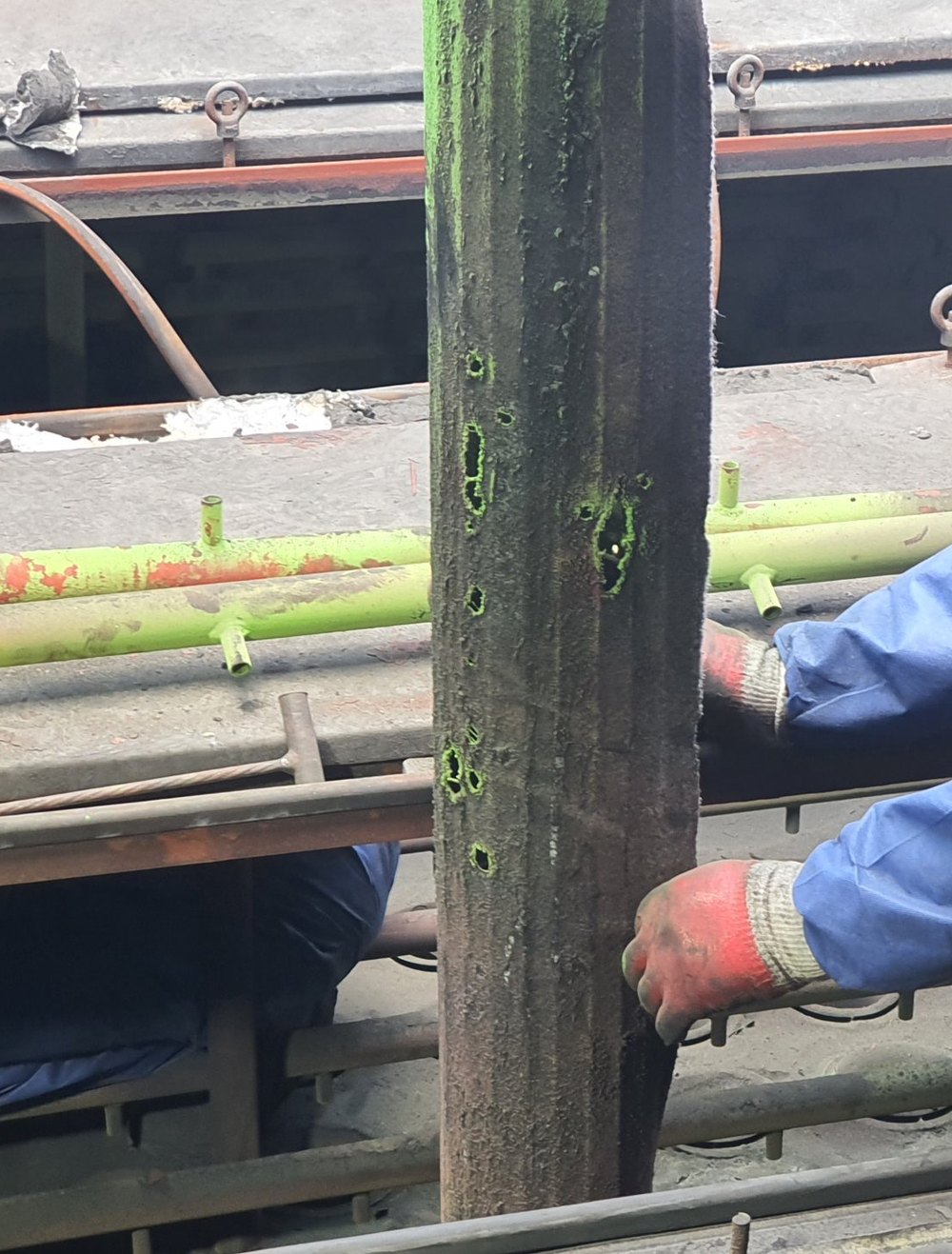
A filter bag removed after a leak test. Green fluorescent powder ringing several holes shows the path the dust took. When holes run in a line like this, check the cage condition and gas flow as well.
Source: Micro-one Co., Ltd. field photo
03 · PROCESS CONDITIONS
What Traces Do Operating Conditions Leave?
Operating conditions leave marks on the media itself, such as melted spots, hardened dust cake and weakened fabric.
- High temperature: Exceeding the maximum operating temperature can cause sudden failure such as melting or fire, and even less obvious overheating makes bags brittle.[4] Using a low-temperature fabric in a high-temperature system quickly leads to failure.[5] For temperature limits by material, see the filter bag material selection guide.
- Moisture: Moisture weakens the media, causing damage and dust leakage, and makes dust hard to clean off so bags blind.[5]
- Gas composition: When the operating temperature falls below the dew point, chemicals in the gas condense on the bags.[4] Acid gases combined with high moisture cause acid to condense and damage both bags and housing.[5] For example, under hot and humid conditions such as gypsum processes, polyester hydrolyzes and becomes hard and brittle.[5] You can check the acid dew point with the acid dew point calculator.
Damage from operating conditions often appears in a similar form on many bags rather than one or two. A rust-red discoloration at the bag top is a sign of corrosion.[1]
04 · DUST PROPERTIES
How Do Dust Properties Relate to Holes?
Holes become more likely when the dust is abrasive, carries moisture, burns easily or arrives with acid gases.
- Abrasive dust: Where gas velocity is high or dust is re-entrained, it can grind away the media and enlarge wear and holes.
- Moisture-laden dust: It becomes sticky, cakes like mud that will not clean off, and blinds the bags.[5]
- Combustible dust and sparks: Sparks that enter burn holes in the bags.[4]
- Acidic gas components: Condensed acid lowers media strength and causes cracks and holes.[1]
Dust properties change when the process, fuel or raw material changes. If holes suddenly increase, check recent process changes first and, if needed, review the filter bag material.
05 · RECORD BEFORE REPLACING
What Should You Record Before Installing New Bags?
A failed bag is evidence of the cause. Recording the items below before installing new bags helps keep the same failure from repeating.
- Location: height of the hole (top, middle, bottom) and its row and column on the baghouse layout
- Pattern: whether several bags have holes of the same shape
- Operating changes: when the differential pressure and stack dust readings started to change
- Process changes: whether the process, fuel or raw material changed recently
- Cleaning system: whether blowpipe alignment and pulse pressure and interval are normal
- Cages: condition of the wires, welds and bottom pan, and whether bag and cage dimensions match
How to pinpoint the failed bag is covered in “How Do You Leak Test Filter Bags?”. For the replacement work, see the filter bag replacement guide.
FAQ
Frequently Asked Questions
Should you look at equipment causes first when holes keep recurring in the same place?
Yes. Holes that cluster and recur in the same location point first to equipment causes such as blowpipe alignment, inlet gas flow or cages. Replacing only the bags without fixing the cause can lead to the same spot failing again.
Can you replace just a few failed bags?
Yes. If holes are limited to a few bags and the rest are in good condition, partial replacement is possible. Check the cause before replacing, and confirm the installation with a leak test afterward. If holes have spread across several areas or the bags are near the end of their life, consider replacing the whole set.
Should failed bags be kept before disposal?
Yes. The hole location, shape and media condition are evidence for judging the cause. Take photos and record the locations. If needed, send the failed bags to Micro-one and we will analyze the cause in detail and provide an analysis report.
- Rathwallner (Evonik Fibres), bulk solids handling 34(2), 2014 (article by a fiber manufacturer author). Link
- W. L. Gore, “3 Baghouse Maintenance Mistakes That Can Cost You Money” (manufacturer material). Link
- Micronics, “Six Types of Bag and Cage Damage” (manufacturer material). Link
- Baghouse.com, article on the main causes of premature filter bag failure (manufacturer material). Link
- Baghouse.com, article on other causes of filter bag failure (manufacturer material). Link