

How Can Refineries and Chemical Plants Reduce HCN Emissions?
From where it forms to Korea's emission limits, and the temperature and byproducts of each control method
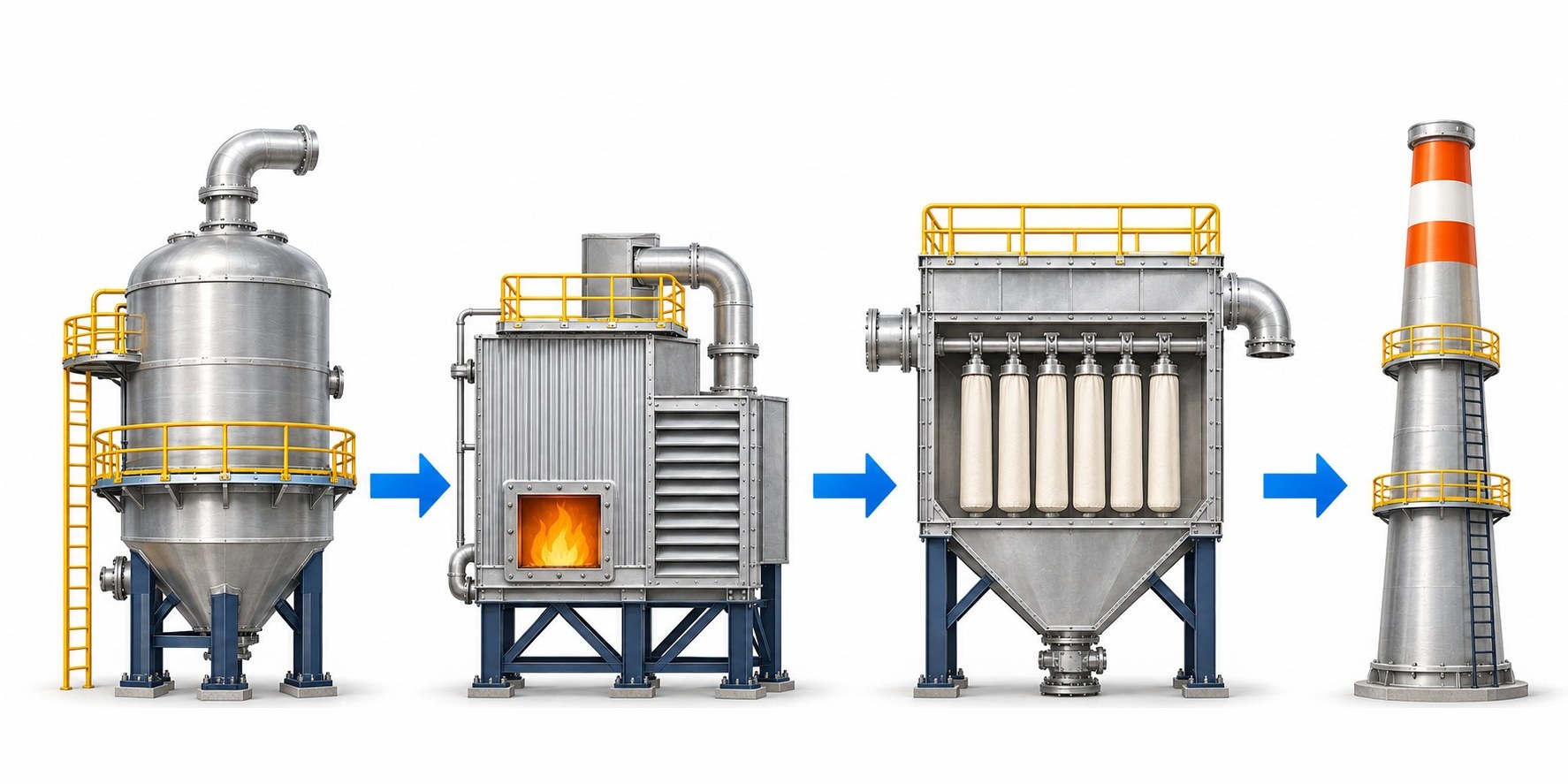
Burns off coke to restore the catalyst; HCN forms at this stage.
Where installed, burns CO and reduced species.
Where compliance with emission limits is checked.
Figure 1. Flue gas path from the FCC regenerator to the baghouse (concept diagram)
Source: Based on Micro-one in-house technical data · AI-assisted concept illustration · Not actual shape or dimensions
01 · SOURCES
Where Does HCN Come From in Refineries and Chemical Plants?
At refineries and chemical plants, HCN comes mainly from FCC regenerators and acrylonitrile production. Hydrogen cyanide (HCN) is a toxic gas that can form when nitrogen-containing coke or waste gas is burned. In Korea, it is regulated in ppm under Annex 8 of the Enforcement Rule of the Clean Air Conservation Act.[1]
FCC Regenerator: Coke Nitrogen Turns Into HCN First
The FCC regenerator restores the catalyst by burning off the coke deposited on it. When the nitrogen in the coke burns, much of it first becomes HCN; part of that reacts with steam to form NH₃, or is oxidized to N₂ and NO.[2] In full-burn operation with ample oxygen, the nitrogen leaves mainly as N₂ and NO, while in partial-burn operation with too little oxygen, far more reduced nitrogen species such as NH₃ and HCN appear at the regenerator outlet.[2] If a CO boiler follows, the gas is oxidized once more and the stack carries mainly SOx and NOx; without one, CO, NH₃ and HCN are emitted as they are.[2]
Emission Range: Varies Widely From Unit to Unit
According to a 2016 presentation by TRC Solutions, only 9 of the 22 FCC reports reviewed by EPA (covering 8 units) were usable, and emissions ranged from 0.001 to 0.022 lb HCN per barrel of feed.[3] Concawe gives emission factors per tonne of coke of 0.58 kg for full-burn units and 0.042 kg for partial-burn units.[4] Because the two figures use different bases, we do not convert or compare them. Operating factors such as whether a CO boiler is used also affect HCN emissions,[3] so differences in factors should not be read as one unit being better than another.
Acrylonitrile: Crude HCN Comes From the Separation Section
Acrylonitrile is made by ammoxidation, reacting propylene with ammonia and oxygen (air) at 400–510°C, and crude hydrogen cyanide is produced in the section that separates the absorber solution.[5] Off-gas from the absorber is either vented directly or sent to an incinerator.[5]
| Source | Why HCN Forms | Conditions and Figures in the Literature | Equipment Before the Stack |
|---|---|---|---|
| FCC full burn | Part of the coke nitrogen becomes HCN as it burns.[2] | With ample oxygen, nitrogen leaves mainly as N₂ and NO.[2] Factor of 0.58 kg per tonne of coke[4] | Check plant by plant |
| FCC partial burn + CO boiler | With too little oxygen, reduced nitrogen (NH₃, HCN) is abundant at the regenerator outlet.[2] | Oxidized again in the CO boiler, leaving mainly SOx and NOx at the stack.[2] Factor of 0.042 kg per tonne of coke[4] | CO boiler (without one, CO, NH₃ and HCN are emitted as they are)[2] |
| Acrylonitrile waste gas incineration | Crude HCN comes from the separation section after ammoxidation.[5] | Reactor at 400–510°C. Absorber off-gas is vented directly or incinerated[5] | Waste gas incinerator |
02 · REGULATION
What Are the HCN Emission Limits in ppm?
Korea's general limit is 4 ppm or less. Since January 1, 2020, Annex 8 of the Enforcement Rule of Korea's Clean Air Conservation Act has set hydrogen cyanide limits of 8 ppm or less for waste gas incinerators at acrylonitrile plants and 4 ppm or less for all other emission facilities.[1]
For sites that emit 10 tonnes or more per year of any single specified hazardous air pollutant, the limits are 6 ppm or less and 2 ppm or less, respectively. Until 2019, the limits were 10 ppm or less and 5 ppm or less (10 ppm or less and 3 ppm or less for sites emitting 10 tonnes or more per year).[1] Which category a given unit falls into should be confirmed directly in Annex 8.
In the United States, EPA's 2015 amendments to the Petroleum Refinery MACT (Refinery MACT 2) required a one-time HCN emissions test for FCC units, due by August 1, 2017.[6] This article presents it as a one-time testing requirement, not an emission limit.
| Category | Applies To | Limit or Requirement | Basis |
|---|---|---|---|
| Korea, general (from Jan. 1, 2020) | Waste gas incinerators at acrylonitrile plants / other emission facilities | 8 ppm or less / 4 ppm or less | Korea's Clean Air Conservation Act Enforcement Rule, Annex 8[1] |
| Korea, 10 t/yr or more | Sites emitting 10 t/yr or more of a single specified hazardous air pollutant (same two categories as above) | 6 ppm or less / 2 ppm or less | Annex 8[1] |
| Korea, until 2019 | Waste gas incinerators at acrylonitrile plants / other emission facilities (10 / 3 ppm for sites at 10 t/yr or more) | 10 ppm or less / 5 ppm or less | Annex 8[1] |
| US FCC | FCC units | One-time HCN emissions test (by Aug. 1, 2017) | 80 FR 75178 (2015)[6] |
03 · OPTIONS
What HCN Control Options Are There?
This article groups the control methods into six: combustion, catalytic hydrolysis, catalytic oxidation, adsorption (+ catalyst), alkaline scrubbing and catalytic filter bags. Concawe notes that existing flue gas treatment technologies were not designed specifically to control HCN emissions,[4] so the temperature range and remaining byproducts of each method should be checked first.
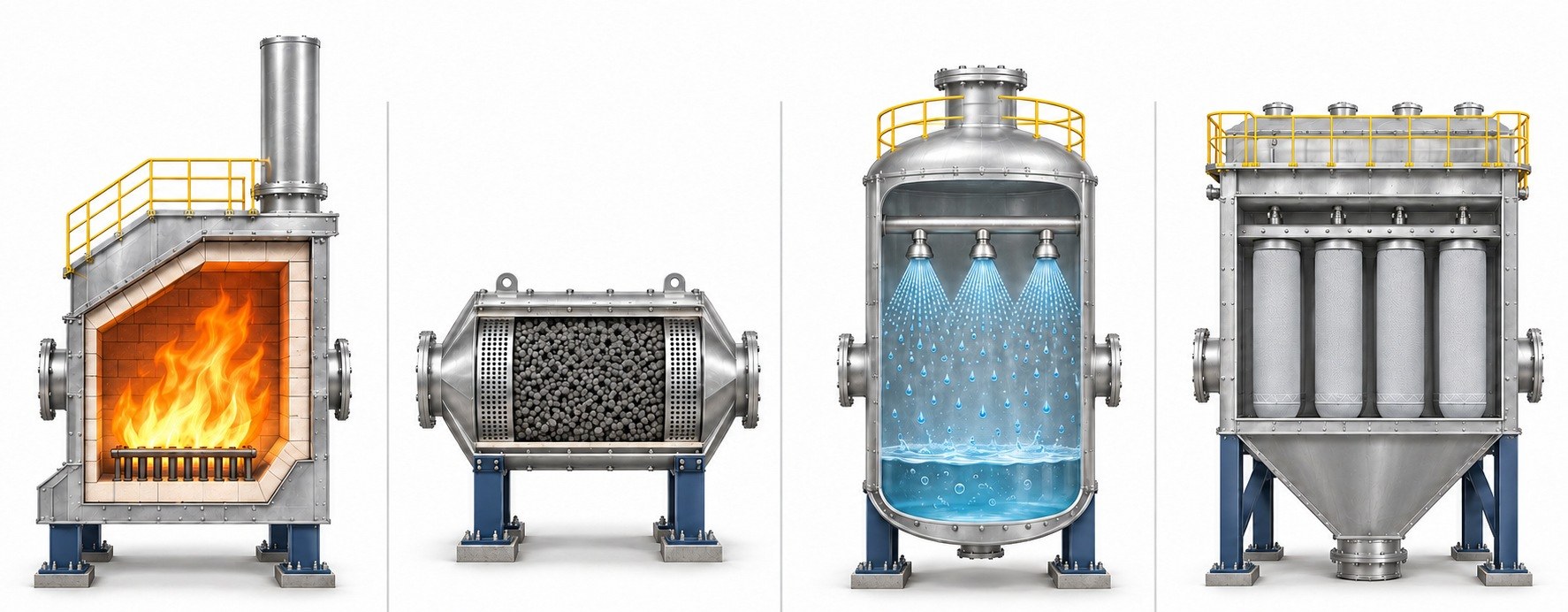
Burns HCN in a CO boiler or incinerator.
A fixed-bed catalyst placed in the ductwork.
Washes the flue gas with an alkaline solution.
Treats the gas in place of the filter bags inside the baghouse.
Figure 2. Where each HCN control method is installed (concept diagram)
Source: Based on Micro-one in-house technical data · AI-assisted concept illustration · Not actual shape or dimensions
Combustion (CO Boiler, Incineration): HCN Becomes NOx
Combustion oxidizes reduced nitrogen species. However, an FCC stack downstream of a CO boiler carries mainly SOx and NOx,[2] and some sources state that HCN is converted to NOx.[3][7] Combustion reduces HCN, but NOx control follows.
Catalytic Hydrolysis: HCN Becomes NH₃ and CO
HCN reacts with steam to form NH₃ and CO (HCN + H₂O → NH₃ + CO).[8] TiO₂ (anatase) showed about twice the activity of Al₂O₃.[8] For a Cu–Ni/γ-Al₂O₃ catalyst tested at 100–500°C, the authors identified 400°C as the optimum, and removal peaked close to 99% at an H₂O/HCN volume ratio of 150.[9] With oxygen present, HCN removal and NOx formation increased while NH₃ formation decreased.[9] All of these are laboratory results, not commercial performance.
Catalytic Oxidation: High Conversion Above 250°C, With N₂O and NOx Byproducts
A 0.5% Pt/Al₂O₃ catalyst reached 95% HCN conversion above 250°C, with N₂O, NO and NO₂ observed as products.[10] Pt and Pd catalysts are highly active above roughly 250–300°C but form N₂O and NOx as byproducts, while Cu-ZSM-5 and others have been reported to give similar conversion with better N₂ selectivity.[8]
Adsorption (+ Catalyst): Copper-Loaded Activated Carbon at 200–350°C
Copper-loaded activated carbon (AC-Cu) exceeded 96% HCN conversion at 200–350°C, with N₂O and NOx formed as byproducts (amounts depend on conditions).[11] (The authors explain this as catalytic hydrolysis and oxidation.)
Alkaline Scrubbing: Chemical Consumption and Wastewater Follow
The background section of a patent states that strong alkaline scrubbing is one way to remove HCN completely, but that it also absorbs CO₂, which raises chemical consumption.[7] This cannot be generalized to every scrubbing process, and because cyanide moves into the scrubbing liquor, wastewater treatment equipment has to be considered as well.
Catalytic Filter Bags: Dust and HCN Together Inside the Baghouse
Micro-one describes catalytic filter bags as a way to treat dust and HCN together in a single unit, centered on a filter bag change, where a baghouse is already in place and the flue gas temperature fits. CataFill™ applies to flue gas at 120–200°C, and its structure is shown on the R&D Center catalytic filter page.
04 · COMPARISON
How Do You Choose a Control Method?
Narrow the options by flue gas temperature, then screen them by whether the byproducts can be handled and whether there is installation space.
- Temperature: Match the literature temperatures in Table 3 against your flue gas temperature.
- Oxygen and moisture: Steam is a reactant in hydrolysis, and oxygen can increase NOx.[9]
- NOx: When NOx is present, NH₃ formed from HCN can be converted to N₂ by the SCR reaction.[8]
- Dust and poisons: Check for dust and for components that can poison the catalyst.
- Space: Check whether there is room for a reactor, adsorber or scrubber.
| Method | Temperature (Literature Test Conditions / Product Operating Range) | Main Byproducts | Additional Space | Retrofit of Existing Equipment |
|---|---|---|---|---|
| Combustion | Unit-specific | NOx | Unit-specific (depends on whether an existing CO boiler or incinerator can be used) | Largely new installation |
| Catalytic hydrolysis | Tested at 100–500°C, optimum 400°C[9] | NH₃ | Reactor | Ductwork modification |
| Catalytic oxidation | 250°C and above[10] | N₂O, NOx | Reactor | Ductwork modification |
| Adsorption (+ catalyst) | 200–350°C[11] | N₂O, NOx | Adsorber | Ductwork modification |
| Alkaline scrubbing | Wet | Cyanide wastewater | Scrubber and wastewater equipment | Largely new installation |
| Catalytic filter bags | CataFill™ operating temperature 120–200°C | Depends on catalyst formulation | Treated inside the baghouse | Centered on filter bag change (where a baghouse exists; check cages and pressure drop) |
When Catalytic Filter Bags Are Not the Right Fit
- Processes without a baghouse: There is no place to change filter bags, so look at a fixed-bed catalyst or combustion.
- Processes with flue gas outside 120–200°C: Compare other methods.
- No plan for handling byproducts: Depending on the catalyst formulation, NH₃ or NOx may remain, so decide how to treat them at the same time.
Whether a retrofit is possible is covered in the article “Can You Retrofit Catalytic Filter Bags Into an Existing Baghouse?”, and the principle of treating dust and NOx together in “How Do Catalytic Filters Remove Dust and NOx Together?”. Check items are listed in the engineering guide.
What to Check Before Choosing: Start With Measurement
- Measure together: Measure HCN, NOx, NH₃, O₂, H₂O and temperature at the same time. More oxygen can lower HCN but raise NOx.[9]
- Know the interferences: With the alkaline absorption method (OTM-29), CO₂ and sulfides cause errors; with FTIR, moisture and cold spots in the sample line do, so an experienced testing firm is needed.[3]
- Compare before and after: Combustion mode and the presence of a CO boiler change HCN, so measure with the same method before and after any operating change.[4][3]
- Decide from the results: If the limit is exceeded, start with the methods in Table 3 that fit your temperature, and review equipment to handle the remaining byproducts at the same time. Limits and decisions are set by the responsible engineer at each site.
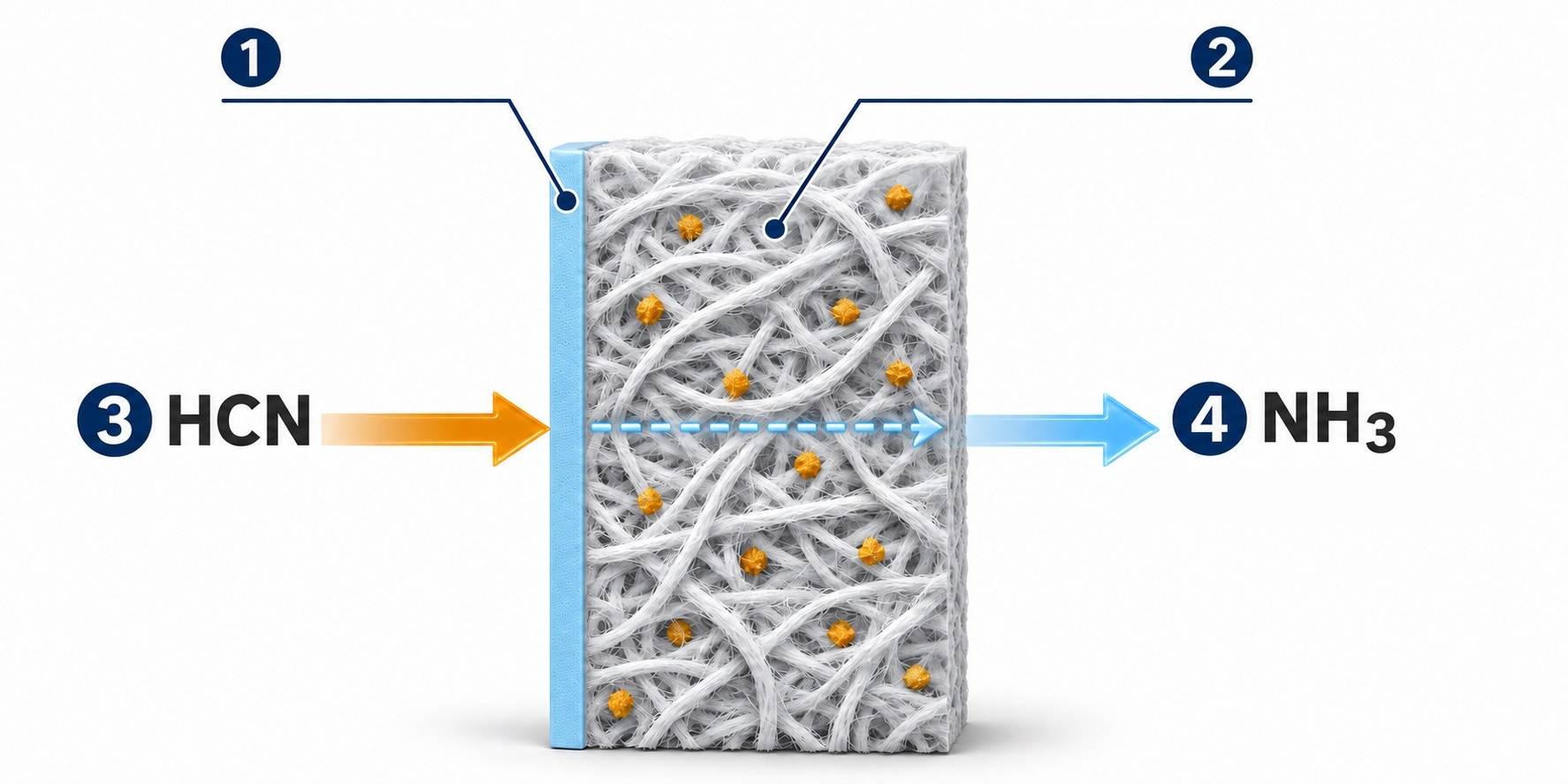
A thin membrane laminated flat on the catalytic felt.
A PTFE nonwoven felt loaded with catalyst.
HCN contained in the flue gas.
A possible byproduct of hydrolysis-type catalysts; varies with the catalyst formulation.
Figure 3. Cross-section of a catalytic filter bag wall (concept diagram)
Source: Based on Micro-one in-house technical data · AI-assisted concept illustration · Not actual shape or dimensions
05 · FIELD CASE
How Has It Been Applied at Korean Plants?
In 2026, Micro-one delivered 840 CataFill™-DHX bags to refinery and petrochemical plants of a major Korean company, reducing HCN emissions by 90% or more. DeNOx and DeHCN catalysts are supplied commercially, and CO and other targets are reviewed as custom designs. This record reflects the results at that site, so before applying it elsewhere, check the flue gas temperature, oxygen and moisture, NOx, and baghouse configuration first.
FAQ
Frequently Asked Questions
How is HCN measured at the stack?
It is measured with the alkaline absorption method (OTM-29) or FTIR. Both methods are subject to interferences such as CO₂ and sulfides, moisture, and cold spots in the sample line, so an experienced testing firm is needed.
Does a CO boiler also reduce HCN?
It can. However, part of the HCN may be converted to NOx in the CO boiler, so NOx control has to be considered as well.
What happens to the NH₃ formed by hydrolysis?
NH₃ can remain in the flue gas, and with oxygen present, part of it may be oxidized and increase NOx. If NOx is also present, it can be converted to N₂ through the SCR reaction.
Are the limits stricter for sites emitting 10 tonnes or more per year?
Yes. Under Korea's standard, 2 ppm (6 ppm for incinerators) applies instead of the general 4 ppm (8 ppm for incinerators). Check the applicable category in Annex 8.
- Korea Law Information Center, Enforcement Rule of the Clean Air Conservation Act (대기환경보전법 시행규칙), Annex 8: Emission Limits for Air Pollutants (amended Nov. 4, 2026, Ministry of Climate, Energy and Environment Ordinance No. 67). Link
- Johnson Matthey, “HCN and NOx control strategies in the FCC,” Digital Refining. (manufacturer literature; used only to explain how HCN forms) Link
- TRC Solutions, “Measurement of Hydrogen Cyanide Air Emissions in Refinery Operations,” IPEC 2016. Link
- Concawe, “An overview of HCN emissions from FCCUs and their potential impacts on human health,” Report 1/19, 2019. Link
- European Environment Agency, “EMEP/CORINAIR Emission Inventory Guidebook, B4520 Acrylonitrile,” 2006. Link
- U.S. EPA, “Petroleum Refinery Sector Risk and Technology Review and New Source Performance Standards,” 80 Federal Register 75178, 2015. Link
- Degussa GmbH, “Process for the separation of hydrogen cyanide from gases and waste gases,” US 5,200,161, 1993. Link
- Kröcher, O., Elsener, M., “Hydrolysis and oxidation of gaseous HCN over heterogeneous catalysts,” Applied Catalysis B: Environmental 92, 75–89, 2009. Link
- Yan, L. et al., “Catalytic hydrolysis of gaseous HCN over Cu–Ni/γ-Al2O3 catalyst: parameters and conditions,” Frontiers of Environmental Science and Engineering 10(6), 2016. Link
- “Catalytic oxidation of HCN over a 0.5% Pt/Al2O3 catalyst,” Applied Catalysis B: Environmental 65, 282–290, 2006. Link
- “Coupling catalytic hydrolysis and oxidation on metal-modified activated carbon for HCN removal,” RSC Advances 6, 57108–57116, 2016. Link